The Economics of AI Are Starting to Matter
Over the last few months, almost every major AI company has started talking about the same thing. OpenAI is releasing smaller and more efficient models. Google keeps highlighting lower inference costs and faster serving. Anthropic frequently discusses performance per dollar. At first glance these seem like independent product decisions, but they all point toward the same market shift.

For the last few years, the AI race was simple: build the smartest model. More parameters. More compute. More training data. More intelligence. The assumption was that whoever built the most capable model would eventually dominate the market.
But AI companies have started running into a different problem. Cost. Every AI response requires computation. Every generated image requires computation. Every coding task requires computation. Unlike traditional software, AI becomes more expensive as usage increases. The more successful the product becomes, the larger the infrastructure bill gets.
This has forced the industry to rethink its priorities. A model that is 10% smarter but costs twice as much to run is not necessarily a better business. A slightly less capable model that is significantly cheaper may ultimately create more value.
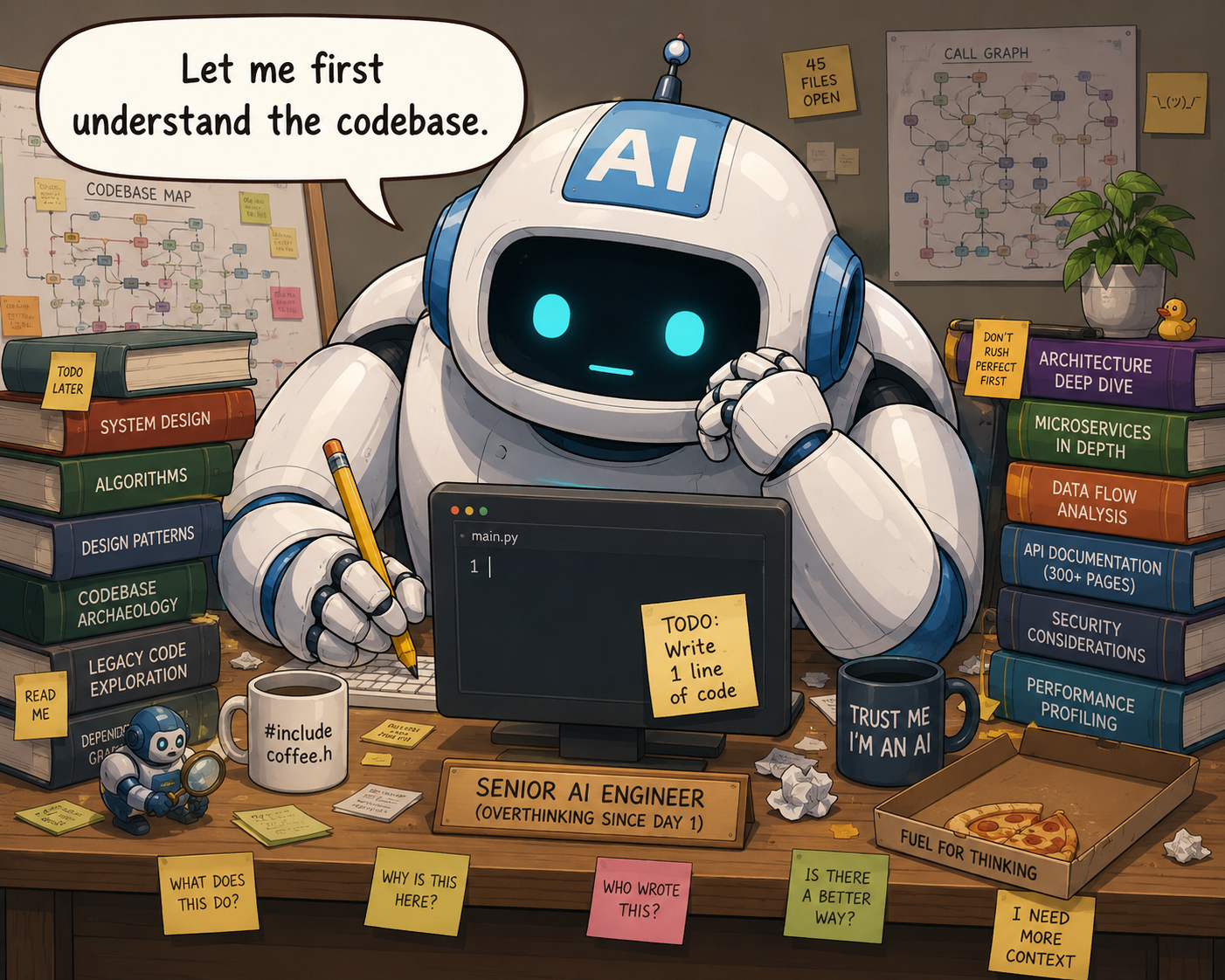
But there is another cost problem emerging beneath the surface - one that most people are not paying attention to. Humans accumulate context. AI rebuilds it.
When a software engineer works on a feature, they already understand the system. They know previous decisions, architectural trade-offs, and where important pieces of code are located. That knowledge compounds over time and makes future work cheaper. AI works differently. When an AI agent is assigned a task, it often has to read files again, analyze dependencies again, and reconstruct understanding that may have already been generated before. The same codebase gets processed repeatedly. The same context gets rebuilt repeatedly. The same computation gets paid for repeatedly. A human carries context forward. An AI frequently has to repurchase it.
As AI agents become more common, this becomes an economic problem. The cost is not only generating answers - the cost is generating understanding. This is why companies are investing heavily in memory systems, context management, model compression, quantization, custom chips, and inference optimization. At first glance these appear to be separate technologies. In reality they are all trying to solve the same problem: how do you reduce the cost of intelligence?
The bigger picture is that AI is starting to follow the same pattern as every major technology wave before it. Computers became mainstream when hardware became cheaper. The internet exploded when bandwidth became cheaper. Cloud computing transformed software when infrastructure became cheaper. AI is now entering the same phase. The question is no longer whether intelligence can be created. The question is how cheaply it can be delivered.
Why It Matters:
Every major technology wave followed the same pattern - it became truly transformative not when it became capable, but when it became affordable. Computers changed the world when hardware got cheap. The internet exploded when bandwidth got cheap. The question for AI is when inference gets cheap enough that the products which look impractical today become obvious.
That inflection point is approaching. If inference costs drop 10x in the next two years - which the current trajectory suggests - the economics of AI-powered products change entirely. Features that were too expensive to ship become standard. Workflows that required human labor become automatable. Entire business models that weren't viable yesterday start making sense.
The intelligence breakthrough may have already happened. The economic breakthrough - the moment AI becomes cheap enough to be embedded in everything - is where most of the value will actually be created. And most people are still watching the benchmark leaderboard instead.