Pokemon Go Was Always a Data Collection Project
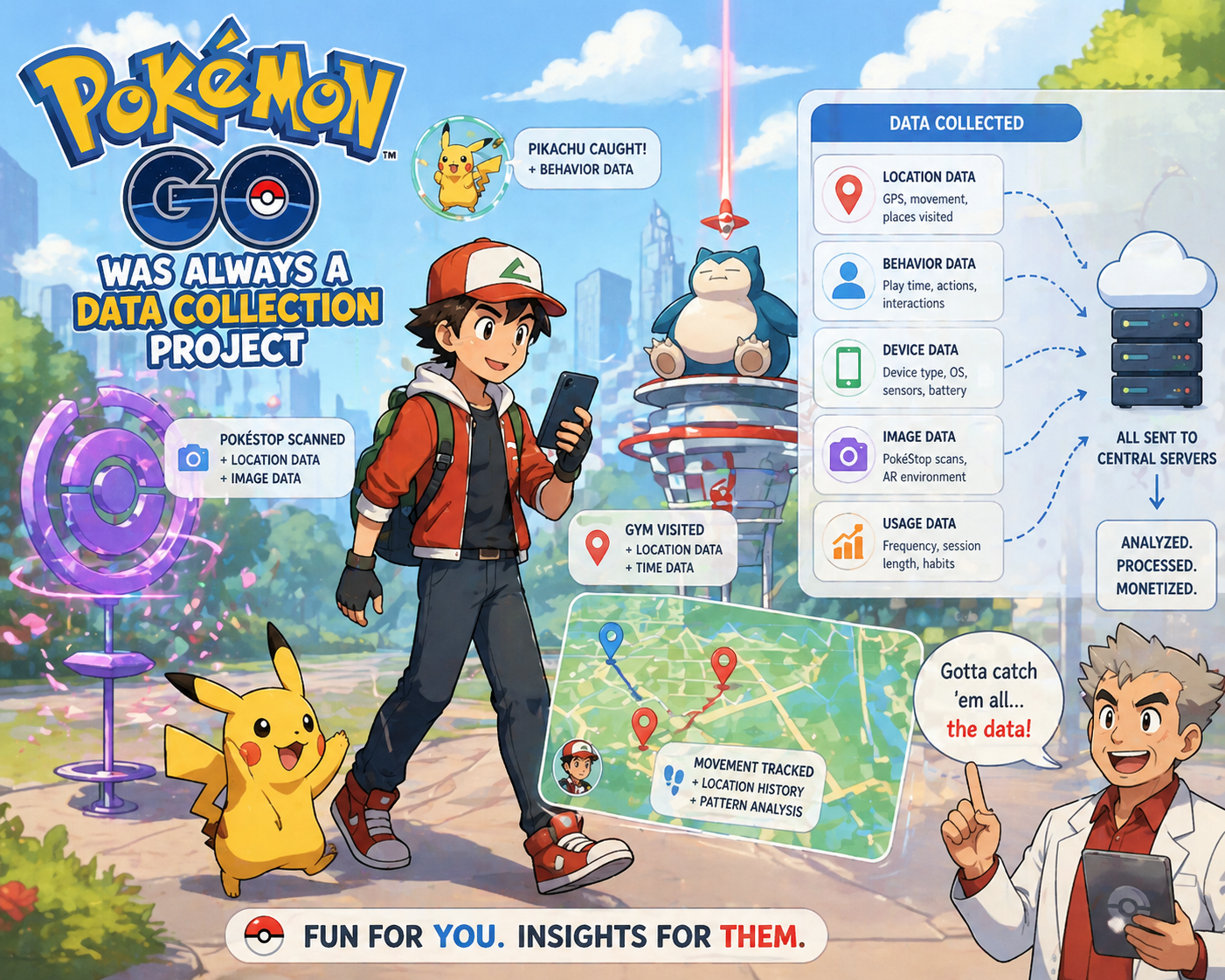
Pokemon Go was the world's first augmented-reality hit. Released in 2016, it broke records overnight - millions of people walking around cities, pointing their phones at the real world to catch virtual creatures. It felt like a game. But the company behind it was quietly building something far more valuable than a gaming franchise - which they were not even aware of at the time.
Every time a player pointed their phone at a Pokestop or a gym, Niantic's servers were logging images, landmarks, and hyper-accurate location markers tied to the physical world. Multiply that across hundreds of millions of players over nearly a decade and you have one of the most detailed crowdsourced spatial maps ever built - gathered by people who had no idea they were building it.
The company has since rebranded its deeper ambitions under the name Niantic Spatial. Their latest product is a spatial AI model that can pinpoint a location on a map to within a few centimeters - based on just a handful of visual inputs. That's not GPS. GPS gives you a few meters. This is a completely different level of precision, and it's only possible because the model was trained on years of real-world imagery taken from real streets, real angles, and real lighting conditions.
Now Niantic Spatial has partnered with Coco Robotics- a startup deploying sidewalk delivery robots across cities in Europe and the US. The connection is obvious. A delivery robot navigating a busy pavement, stopping at the right door, avoiding pedestrians - it needs inch-perfect location awareness. That's exactly what a decade of Pokemon Go players unknowingly built.
Why It Matters:
The most valuable AI training data in the next decade won't come from scraping the web. It will come from products people genuinely use every day - fitness apps, navigation tools, AR experiences, delivery platforms. The data gets collected as a side effect of the product working. That's what makes it so hard to replicate.
Niantic didn't set out to build a spatial AI company. They built a game, and the game built the dataset. A decade later, that dataset is powering centimeter-accurate location models and real-world robotics. The infrastructure was assembled before anyone knew what it would be used for.
If you're building a consumer product today, the question worth asking is: what data is this generating, and what could it power five years from now? The companies thinking about that now are already building a moat most of their competitors won't see coming.